Showing posts with label SAN FERNANDO PAMPANGA. Show all posts

Wednesday, April 30, 2025

Attending a Priestly Anniversary in Masantol, Pampanga

I had the opportunity to revisit the town of Masantol when my classmate, Fr. Roland “Bogs” Moraleja, invited me to attend the celebration of his 40th priestly anniversary. Instead of holding the Mass in his parish church, he chose to celebrate both the Mass and the reception at the Masantol Civic Center, located at the town's entrance. The decision was made primarily due to the limited parking space at the parish church, which could not accommodate the expected number of guests.

After the reception, I made my way to the town proper to take some photos of the church. Masantol is known for frequent flooding, not only during the rainy season but even during high tides. Fr. Bogs shared that he had already raised the floor of the church by a few  meters, yet it was still inundated during the most recent rains. Driving through Macabebe and Masantol, I passed by houses partially submerged in water, a striking reminder of the area's vulnerability.

          Since Macabebe lies just before Masantol along the route, I also took the opportunity to visit its parish church—a quiet but meaningful stop along the way. 


The ground floor of some houses along the way to Masantol are under water. 


With my classmate Fr. Bogs Moraleja

The Masantol Civic Center where the 40th anniversary of Fr. Bogs was celebrated. It is surrounded by water. 


Fr. Bogs in the center with contemporaries from UST Central Seminary. 

St. Michael the Archangel Parish (F-1893)
Masantol, Pampanga


The church, which was painted green during my first visit, had since been repainted white. I also noticed that the altar had been renovated—the retablo now spans the entire backdrop of the sanctuary, giving it a fuller and more striking presence.


San Nicolas de Tolentino Parish (F-1575)
Macabebe, Pampanga

I did not notice any changes in the church since my last visit, except for the fading paint.


Note the sunken base of the pulpit, which proves that the flooring has been raised. 

For the previous post on Masantol and Macabebe churches, click here.

Saturday, June 13, 2015

CHURCHES OF PAMPANGA: Part One

This post would feature five parish churches and one chapel in Pampanga. They are the following: the Metropolitan Cathedral of San Fernando, the Arzobispado Chapel, the San Guillermo Parish Church of Bacolor, the  parish church of Betis, the San Agustin parish church of Lubao and the Sta. Catalina de Alejandria parish church of Porac. 

METROPOLITAN CATHEDRAL OF SAN FERNANDO
SAN FERNANDO, PAMPANGA
Founded: 1754

The town of San Fernando was founded by the Augustinians in 1754.  The church was built in 1756 by Fr. Sebastian Moreno and completed by Fr. Mariano Alafont in 1781. In December 11, 1948 San Fernando was created as a diocese and the church of San Fernando became the Cathedral Church. The church is  dedicated to Our Lady of the Assumption but its primary patron is St. Ferdinand, King. 

The Cathedral of San Fernando, Pampanga. 


Newly repainted Cathedral Church of San Fernando. 

The dome with octagonal designs. 

The pulpit. 

Installation of the new Archbishop of San Fernando: Abp. Florentino Lavarias on October 27, 2014. 


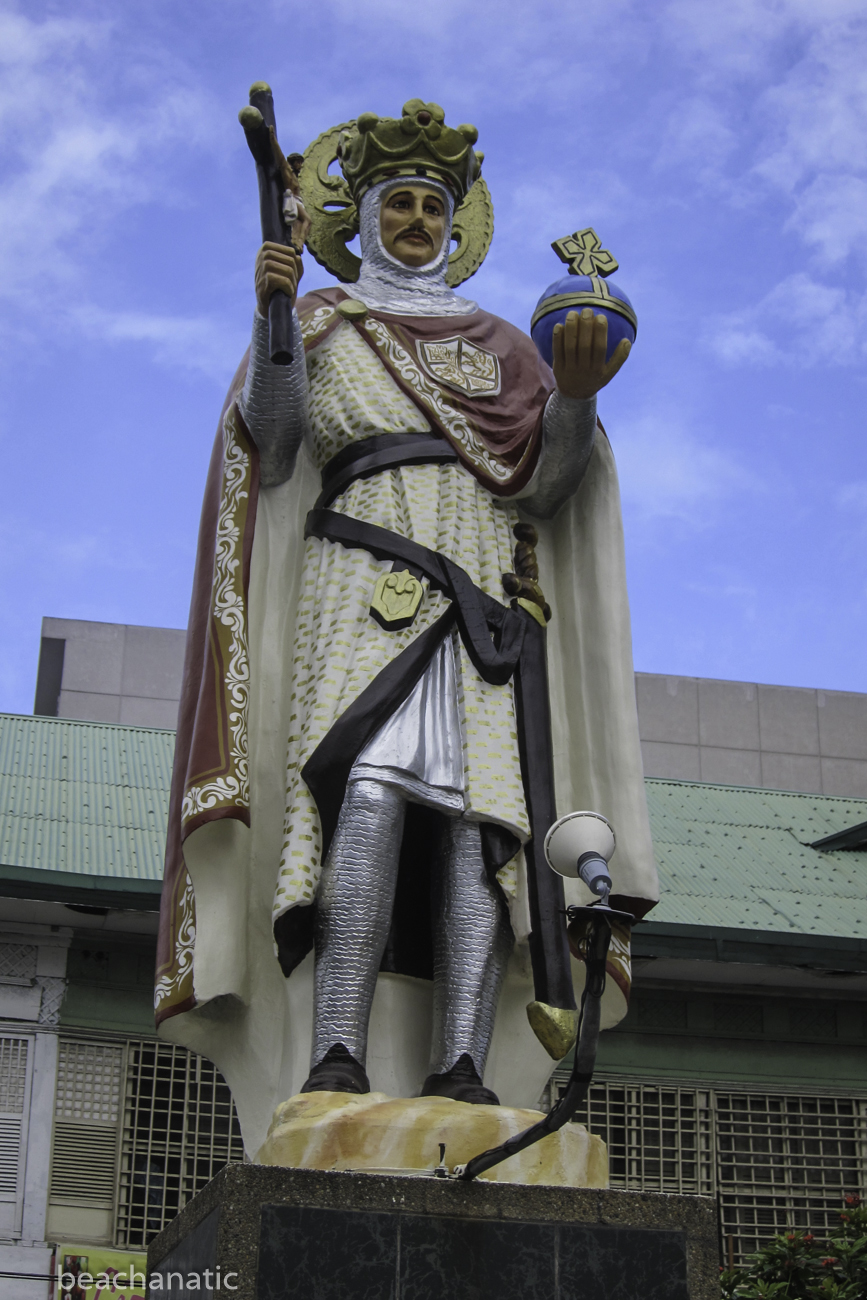
The statue of San Fernando outside of the Cathedral. 


ARZOBISPADO CHAPEL
San Fernando, Pampanga


The Chapel at the Arzobispado in San Fernando, Pampanga. 


Interior of the Arzobispado chapel. 


SAN GUILLERMO PARISH CHURCH
BACOLOR, PAMPANGA
Founded:1576


The church of Bacolor dedicated to San Guillermo as its patron saint was originally constructed by the Augustinians in 1576. It was destroyed I 1880 by an earthquake only to be rebuilt in 1886.  In September 3, 1995 lahar flow from the slope of Mt. Pinatubo which erupted four years before on June 15, 1991 buried the church at half its twelve meter height prompting its more than fifty thousand residents to evacuate to safer grounds in resettlement areas.   The retablo was dug out from the lahar and in order to add more height, the ceiling was removed. 

The present doors where actually the arched windows on the second level of the church. 


The retablo was dug out from the lahar and restored to its present state. 

The side altars were likewise dug out from the lahar that covered them. 


The half buried church of Bacolor. 

The old convento now serves as a museum. 


SANTIAGO APOSTOL PARISH CHURCH
BETIS, GUAGUA, PAMPANGA
Founded: 1660


The town of Betis was founded by the Augustinians in 1660 with St. James the Apostle as its patron saint. It is a town of  master carvers. This talent was used in the different artworks found in the church like the ornately carved designs of the retablo and the stations of the cross.  The mural paintings on the ceiling was extensively done in 1939 under the last Spanish friar who served as parish priest, Fr. Santiago Blanco, OSA. Native painter Macario Ligon was commissioned to do the painting. Later in the 70s and early 80s, his nephew Victor Ramos would restore 80 percent of the mural paintings as the wooden panels were already decaying due to termite infestation. Because of migration, the town of Betis would be merged with the town of Guagua in 1904. The church of Betis was declared as a national cultural treasure in 1972.   


Mural paintings on the ceiling of the church. 


Carved Stations of the Cross. 

Ornately designed and carved retablo. 


The floor of the church is made of wood. 


Baptistery with a painting of the baptism of Jesus by John the Baptist. 

The dome is also filled with mural paintings. 


SAN AGUSTIN PARISH CHURCH
LUBAO, PAMPANGA
Founded: 1572


STA. CATALINA DE ALEJANDRIA PARISH CHURCH
PORAC, PAMPANGA
Founded: 1611


St. Catherine of Alexandria. 


What is a Pilgrimage?

A pilgrimage is a journey for a spiritual reason. It is a journey inward as well as outward. Pilgrims seek to strengthen and renew their faith through travel – a sacred travel. Travel in the context of pilgrims becomes a sacrament. Travel to a sacred place is the outward sign that enables the drawing closer to God which is the inward grace. This is the difference between a pilgrim and a tourist. For a tourist, travel is an end in itself. For a pilgrim, travel is a means to an end. Pilgrims travel with a clear intention, to draw closer to God. The life of a Christian is seen as the lifetime pilgrimage towards the heavenly home. Procession actually and fittingly signifies this life’s pilgrimage.