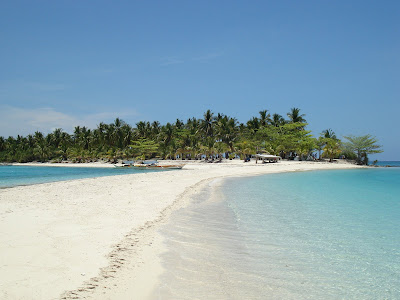
Kalanggaman is a small island paradise with a land area of about two hectares situated between north of Cebu and Leyte. Belonging to the town of Palompon, Leyte, it is about an hour ride by boat either from Palompon or Villaba,Leyte. What makes this island unique is that it has two sand bars , one which protrudes towards the east and the other at the southern end. The eastern sand bar stretches for more than 200 meters into the sea, while the other one is only half as long which is submerged under water during high tides.
The island of Kalanggaman is supposed to have been bought already by one from Cebu who planned to put up a first class resort. The plan was supposedly turned down by the municipal council of Palompon which wanted to keep the place in its pristine state for eco-tourism. Security guards are posted on the island and supposedly is not open for picnics. There are no more islanders there except for some fishermen who make the island as their rest stop before they embark again for fishing.
Together with five other priests ( Frs. Stephen, Louie, Mony, Aaron and Roy) and the families of Atty. Ari Larrazabal and Engr. Oliveros and the convent staff of Villaba, we camped overnight at this island paradise last April 23, 2007. The sea was very calm at this time of the year and we had a good swim in the afternoon and even into the night. Over glasses of tuba and the grilled fishes that were newly caught by the fishermen who were stopping by the island, not to mention the lechon and the other food that we brought along, we had a fun and relaxing time together.
Late in the evening, however, while we were already sleeping, the winds became so strong that our tents were almost being knocked to the ground. I thought there was rain only to find out that it was sand that kept on splashing on our tents. For a moment there, I thought that if the wind would continue until the morning and with the waves so strong we will not be able to return to the mainland on time for our schedules the following day. Thank God, by early morning the wind had died down and the sea was back again to being calm. The crossing from Kalanggaman to Leyte is noted to be treacherous especially towards late in the afternoon. That is why it is always advised to go there in the morning.
Being now under the administration of the local government of Palompon, entrance fees per person are now collected if one visits the island. It is 50 pesos for residents of Palompon and 150 for non-residents. If one stays overnight in the island 200 pesos is collected for the entrance fee and 75 for Palompon residents. Another rental fee for the cottage is also collected. The boat rental for going to Kalanggaman is about 3,500 which has a maximum capacity of 25 persons. For reservations one can contact the Ecotourism Office of Palompon at this number (053) 338-2094.

As one approaches Kalanggaman island from the north, the eastern sand bar stretches very much longer than the island itself.
 The sand bar stretches out far into the shallow waters. Just like in Boracay, the white sand does not get hot even at the scorching heat of the day.


 Under the shade of the Talisay trees, we put up our picnic tables and the food we brought along. We also were able to buy newly caught fish by the fishermen who were making the island as their stopping point.


 At both the eastern and the western part of the island, the shore is covered with slabs of stone as if artificially placed there as a windbreaker. The sea is clear all around. This is the sand bar at the southern end of the island which is more than a hundred meters length. However, this is submerged under water during high tides. The current at the end of the sand bar is so strong that if one is not careful enough, one might be carried out to the ocean.
  Sunset in Kalanggaman


