
As a tourist destination, Surigao del Sur has long been overshadowed by its sister province, Surigao del Norte, particularly because of Siargao, with its famous white-sand beaches and world-class surfing. Surigao del Sur, however, has been steadily emerging as a destination in its own right, offering a different kind of natural beauty—from spectacular waterfalls and enchanting rivers to pristine beaches and picturesque islands scattered throughout the province.
Surigao del Sur is composed of nineteen municipalities, with Tandag City as its provincial capital. Ecclesiastically, the entire province falls under the jurisdiction of the Diocese of Tandag.
I had earlier told Bishop Odchimar, then Bishop of Tandag, that I wanted to visit his diocese before he retired. When I finally informed him of the dates of my visit, he told me that unfortunately he would be away from the diocese at that time. He nevertheless entrusted me to his Vicar General, Msgr. Cid Irizari, who would take care of me during my stay. As it turned out, Msgr. Cid was the perfect host and guide.
Msgr. Cid was already waiting at the airport when I arrived. From there, he brought us to the Bishop’s Residence, where we had lunch. We were told that immediately afterwards we would begin our tour of the province, with the Britania Group of Islands as our first destination.
It was raining as we made our way south. In fact, it had been raining continuously for several days, and there were already reports of flooding farther south in Davao. The skies were so overcast that it seemed much later in the day, even though it was only a little past one in the afternoon when we left the Bishop’s Residence and Pastoral Center.
Britania is part of the municipality of San Agustin, about 80 kilometers from Tandag. At La Enkantada Resort, Msgr. Cid rented a boat for our island-hopping tour. The boat cost ₱1,500 and was large enough to accommodate as many as 35 passengers.
The Britania Group is composed of around twenty small islands and islets, most of them located not far from the mainland. Our first stop was Naked Islet, a small stretch of white sand with only a few coconut trees. Nearby was Vanishing Islet, which had no vegetation at all and, as its name suggests, disappears beneath the water during high tide.
We next stopped at Boslon Island, where there were several small stores. The surrounding water, however, was shallow and covered with seagrass, so we did not stay long. From there, we proceeded to an area with coral formations, where I took the opportunity to jump into the sea and do some snorkeling. At our final stop, we found two other nearby islets that we were able to walk across to because it was low tide.
What I found remarkable was the weather. It had been raining when we began our journey, but as soon as we reached the first islet, the rain stopped and the skies cleared. We were able to enjoy the islands and take our pictures without difficulty. It was only as we were preparing to leave our final stop that the rain began to fall again.
Strangely enough, this became the pattern throughout the three days of my visit to Surigao del Sur. Although it rained almost constantly during our stay, the weather seemed to cooperate whenever we reached our destinations. The rain would stop, sometimes even giving way to sunshine, allowing us to enjoy the sights and take photographs. Then, as soon as we were back on the road, the rain would begin again. At other times, it would pour while we were indoors and ease into a drizzle just as we were ready to leave.
It seemed that even the weather was making room for our journey. God is indeed good.
 |
| There was a heavy rain when we started the island hopping tour. |

 |
| The skies cleared as soon as we docked on the first island. |


 |
| The Vanishing islet. |


 |
| A few corals could be seen. |


From Britania, we made our way back to the parish church of San Agustin, where the parish priest, Fr. Glenn Infiesto, had prepared an early supper for us. From there, we were to proceed farther south to Bislig, the second-largest city in Surigao del Sur and one of the southernmost areas of the province. We planned to spend the night there so that we could visit Tinuy-an Falls early the following day.
We had originally thought that we would return to Tandag that evening, so we had left most of our belongings there. Realizing that we would instead be spending the night in Bislig, we stopped in the town of Barobo along the way to buy some toiletries and other necessities for our overnight stay.
It was already past eight in the evening when we arrived at Forest Grove Parish in Bislig, where the parish priest, Fr. Bebot Pastera, was waiting for us. It was there that we spent the night.
Forest Grove was originally developed as a residential community for employees of PICOP, the large paper mill located in Mangagoy that eventually ceased operations in 2007. Mangagoy, although only a barangay of Bislig, had grown considerably because of the presence of the paper mill. In fact, its commercial development made Mangagoy appear more progressive and bustling than the old town center of Bislig itself.
 |
| An I love Bislig sign by the boulevard along the sea as one approaches the city proper. |

Founded: 1642
 |
| The church was undergoing renovation inside when we visited it. The facade needs a new paint. |
 |
| With a glass wall at the back of the altar, the garden outside served as the backdrop for the altar. |
We had an early breakfast at 6:30 in the morning so that we could cover as much ground as possible during the day. Our first stop was the parish church of Bislig, which was undergoing renovation at the time.
From there, we proceeded to Tinuy-an Falls, about 15 kilometers from the main highway, with part of the journey taking us over unpaved roads. One advantage of visiting Tinuy-an, unlike many other waterfalls, is that no long hike is necessary to reach it. The parking area is located just a short distance from the falls, making it easily accessible.
Since it had been raining continuously for several days, an enormous volume of water was cascading over the falls when we arrived. Stretching about a hundred meters across and dropping some 55 meters, Tinuy-an Falls presented an impressive sight. With its broad curtain of rushing water, it is often described as the “Niagara Falls of the Philippines.”
We climbed to the second level, where we enjoyed bathing beneath one of the smaller cascades. Back at the main level, we also boarded a bamboo raft that brought us closer to the powerful curtain of falling water. With the river swollen by the recent rains, the experience was both exhilarating and unforgettable.

 |
| A hundred meters wide and fifty meters height Tinuyan Falls is considered as the Niagara Falls of the Philippines. At the foreground is the raft that is used to get near the cascading falls. |

 |
| The second level of the falls. |


 |
| The old convento. |


We then continued our journey, stopping at the parish churches of Tagbina and Barobo before proceeding to Lianga, where the parish priest, Fr. Juanito Rosales, graciously hosted us for lunch. After our meal, we continued on to Marihatag, whose parish church would be our final stop along this stretch of the journey.
I had hoped that we could also pass through Cagwait to see at least its famous white-sand beach, but we were already running out of time. We had to return to the Pastoral Center, where another vehicle was waiting to take us to our next destination—Laswitan in Cortes.


 |
| Church altar of Lianga. |
 |
| The convento of the Lianga Parish. |


On our way to Laswitan, about four and a half kilometers from the highway junction, we encountered several cars and motorcycles heading in the opposite direction. We assumed that, since it was already late in the afternoon, most visitors would have left and there would be only a few people remaining. To our surprise, however, the place was still crowded with tourists when we arrived.
To reach the natural pool, we had to make our way down a series of cemented steps. The pool itself was not very large and was surrounded by dark rock formations that separated it from the open sea. What makes Laswitan unique is the way the powerful ocean waves crash against these rocks, sending seawater splashing over them and into the natural pool below.
It is from this spectacular splashing of seawater over the rocks that the place gets its name, Laswitan, derived from the local word laswit, meaning to splash or spray.


 |
| Waves would strike the rocks that separates this pool from the sea, called laswit in the dialect. Hence the name Laswitan. |


The driver suggested that we turn back, so we retraced our route. From the highway, it was about three kilometers to the town proper. When we asked for directions to the church, we were immediately asked which church we were looking for. We specified the Catholic church and were directed to the far end of town, where we found a rather modest structure with only a small space in front.
By the time we arrived, it was already getting dark and the church was closed. I tried to take some pictures of the altar through the metal grilles, but because of the fading light, the photographs did not turn out very clearly.
As we were leaving, we passed a much larger and brightly lit church with many people gathered around it. It was the church of the Iglesia Filipina Independiente, prominently situated in front of the town plaza. I later learned that Cortes had long been considered a stronghold of the Aglipayan Church. This perhaps explained why the main Catholic parish was located not in the town proper but in Burgos, a barangay of Cortes. The Catholic church we had visited in the poblacion was only a chapel.
Third Day
Upon the invitation of Msgr. Cid, I celebrated the first Sunday Mass at the Cathedral of Tandag. I was surprised, however, to discover that the Mass was not being celebrated inside the Cathedral itself but at the covered court of St. Theresa College, located just beside it.
Msgr. Cid later explained that the Cathedral had already received a notice for demolition because of serious structural defects. Only weekday Masses, with smaller congregations, were still being celebrated inside. There was concern that, should a strong earthquake occur during a crowded Sunday Mass, the structure might collapse and endanger the congregation.
A new Cathedral was therefore already being constructed on the outskirts of Tandag City. It would eventually replace the old Cathedral and provide the diocese with a safer and more suitable mother church.
 |
| The old Cathedral which badly needs repairs in front of a new sparkling plaza now looks like an eyesore. |
 |
| The altar of the Cathedral. |
 |
| A newly developed plaza just in front of the Cathedral. At the farthest end is the Provincial Capitol. |
 |
| The Cathedral convento. |

After breakfast at the Cathedral,
we returned to the Pastoral Center. Msgr. Cid told us that he would pick us up
at around ten in the morning, after celebrating his 8:30 a.m. Mass. Our
itinerary for the day would take us through the northern towns of Surigao del
Sur.
Shortly after ten, Msgr. Cid’s
driver picked us up at the Pastoral Center, and we set out on our journey. Our
first stop was the Lanuza Marine Park and Sanctuary. Msgr. Cid told us that it
was an excellent place for snorkeling, with an abundance of reef fish and other
marine life.
Unfortunately, the amihan was
still prevailing at the time, bringing strong winds and rough seas. The waves
were too strong, making swimming and snorkeling inadvisable. We therefore had
to content ourselves with enjoying the scenery from the shore before continuing
our journey northward.


Our next stop was the surfing area in the town of Lanuza. There were several surfers out in the water, taking advantage of the waves. One of them was a young man from Butuan who recognized Msgr. Cid and came over to greet him. Because of the heavy rains during the previous week, the seawater had taken on a brownish color. The waves here were not particularly large, making the area suitable for beginner surfers.
From Lanuza, we proceeded to the town of Cantilan, where we joined the birthday celebration of one of the priests assigned there, Fr. Richard Limbaga. A number of parishioners had also gathered for the occasion, making it a lively and warm celebration.
Afterwards, we continued northward until we reached Carrascal, the northernmost town of Surigao del Sur. Carrascal is a mining town, and the presence of the mining industry was evident in some of the impressive sports facilities and other structures that had been built in the municipality. The impact of mining on the landscape, however, was equally visible. From a distance, we could see mountains whose once-forested slopes had already been stripped of their topsoil—a striking contrast to the lush scenery we had encountered in other parts of the province.


 |
| Giving a short message at the birthday celebration of Fr. Richard Limbaga. |




The northern part of Surigao del Sur is known as CARCANMADCARLAN, a name formed from the municipalities of Carrascal, Cantilan, Madrid, Carmen, and Lanuza, with Cantilan historically serving as the mother town of the area.
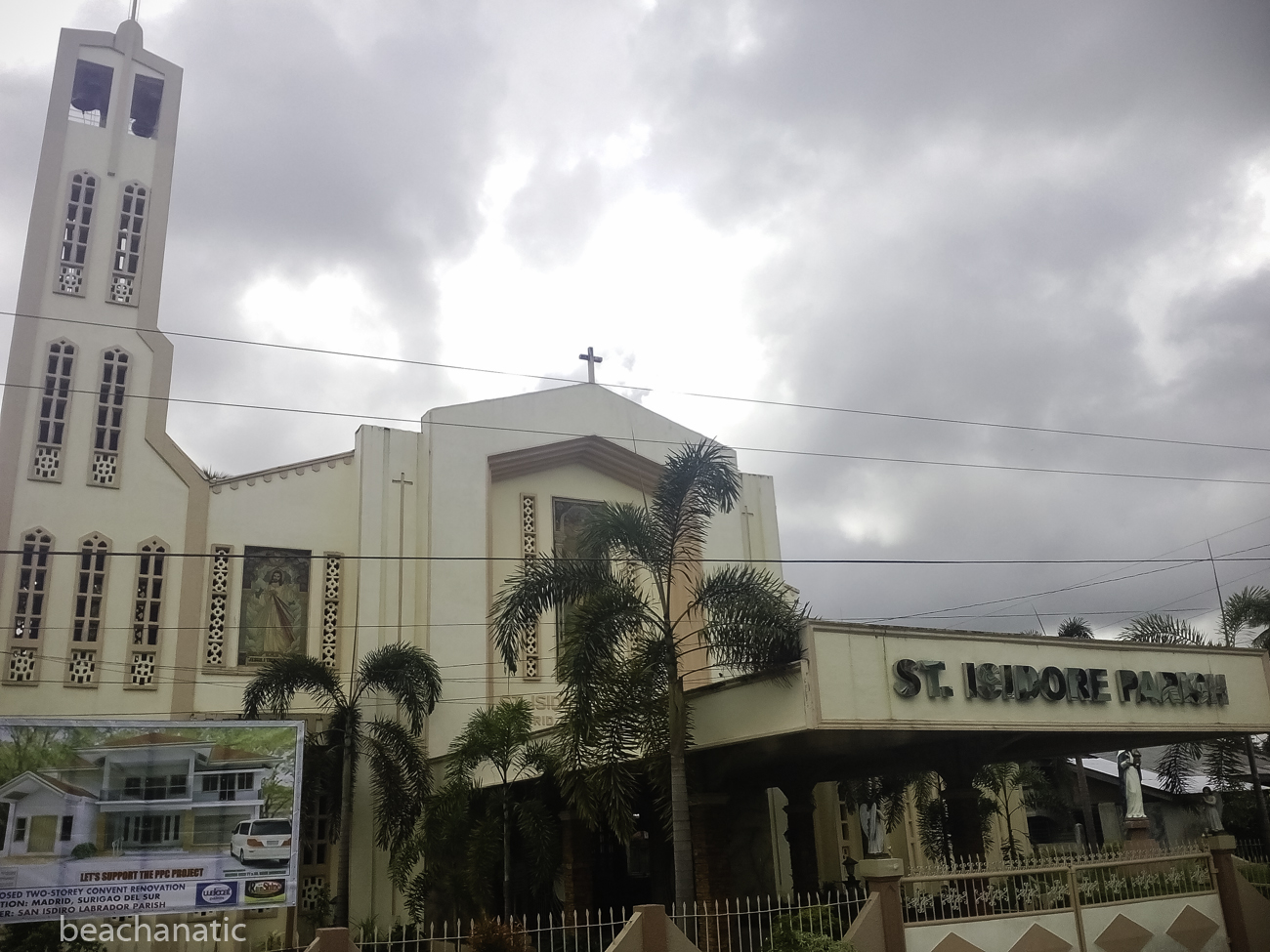
From Carrascal, we began our journey back south, stopping along the way at the parish churches of Madrid, Carmen, and Lanuza. In Carmen, we found the parish priest, Fr. Apple Orosco, hearing the confessions of children who were preparing for their First Holy Communion.
In Lanuza, we first visited the ancestral home of Msgr. Cid, said to be the oldest house in Surigao del Sur, dating back to 1898. An elderly unmarried aunt of Msgr. Cid was still living in the house at the time of our visit.
The house originally belonged to Gabriel Herrera, Msgr. Cid’s maternal great-grandfather. Gabriel Herrera was the first mayor of Cantilan during the period when the five municipalities that now make up CARCANMADCARLAN were still under a single local government. He and his wife had sixteen children, one of whom, Filomeno Herrera, would later become the first mayor of Lanuza when it became an independent municipality.
Thus, the old house was not only a family home but also a tangible link to the political history of Lanuza and the northern towns of Surigao del Sur.
 |
| The Herrera Ancestral home in Lanuza is considered as the oldest house in the province of Surigao del Sur, constructed in 1898. |
 |
| The sala upstairs of the Herrera ancestral home with Msgr. Cid, (left) one of the great grandsons of the original owner. |


 |
| Pastoral Center of the parish of Lanuza. |


From Magkawas Falls, we proceeded to our final stop for the day, Babac Bungalows, a private resort in Lanuza that is also located near one of the town’s surfing areas. The resort was owned by a Filipina married to an Australian, and she also offered yoga classes to guests.
The accommodations consisted of simple native nipa huts, without air-conditioning and cooled only by electric fans, which added to the rustic and laid-back atmosphere of the place.
While we were there, the rain began to pour heavily once again. We did not mind, however, as we were comfortably sheltered while enjoying our afternoon snacks—a delicious seafood pasta accompanied by freshly brewed coffee. It was a pleasant and relaxing way to end our day exploring the northern part of Surigao del Sur.
 |
| Babac Bungalows. |
 |
| It rained hard while we were having our snacks at the Babac Bungalows. |
 |
| The new Cathedral of Tandag undergoing construction. |


.jpg)
.jpg)
.jpg)
.jpg)
.jpg)
From the construction site of the new Cathedral, we proceeded to Cagwait, stopping first at the parish church before heading to the town’s famous white-sand beach. Cagwait White Beach lies along a wide, picturesque cove, with several resorts lining its shores, including one owned and operated by the local government.
From Cagwait, we continued to Bayabas, where we visited the parish church. Bayabas was the hometown of Rolly, the seminarian who had been accompanying us on our journey. Our final stop was the parish church of Tago, completing our tour of Surigao del Sur.
We then returned to the Bishop’s Residence, where an early lunch had been prepared for us before we left for the airport. It was a fitting conclusion to four days of traveling through the province—visiting its churches, waterfalls, rivers, beaches, islands, and communities—before finally catching our flight to Cebu.


 |
| The parish convent of Bayabas |
 |
| A temporary wooden bridge connects to the town proper of Bayabas while a permanent one is being constructed besides it. |


3 comments:
Enjoy the summer with us!
Cape May, The Wildwoods, Avalon, Stone Harbor, Sea Isle City, Ocean City and Atlantic City.
Find our publications at hundreds of locations in Southern New Jersey.
Vacation Time Coupon Books
coupons deals avalon
coupons deals wildwood
wine and brewery tours
Local wine and brewery tours
best wine and brewery tours
Dining and Entertainment Guides
This is such a nice place. Tinuy an falls is really amazing. Hope to visit this place soon. Big thanks for sharing this with us.
Very nice blog. I'm also into photography of churches. How come there are no posts after 2017? Do you have an FB account?
Elmer Domingo
www.elmerdomingo.com
elmerdomingo@gmail.com
Post a Comment